Story from the Vault
The Last Ronin (2022)
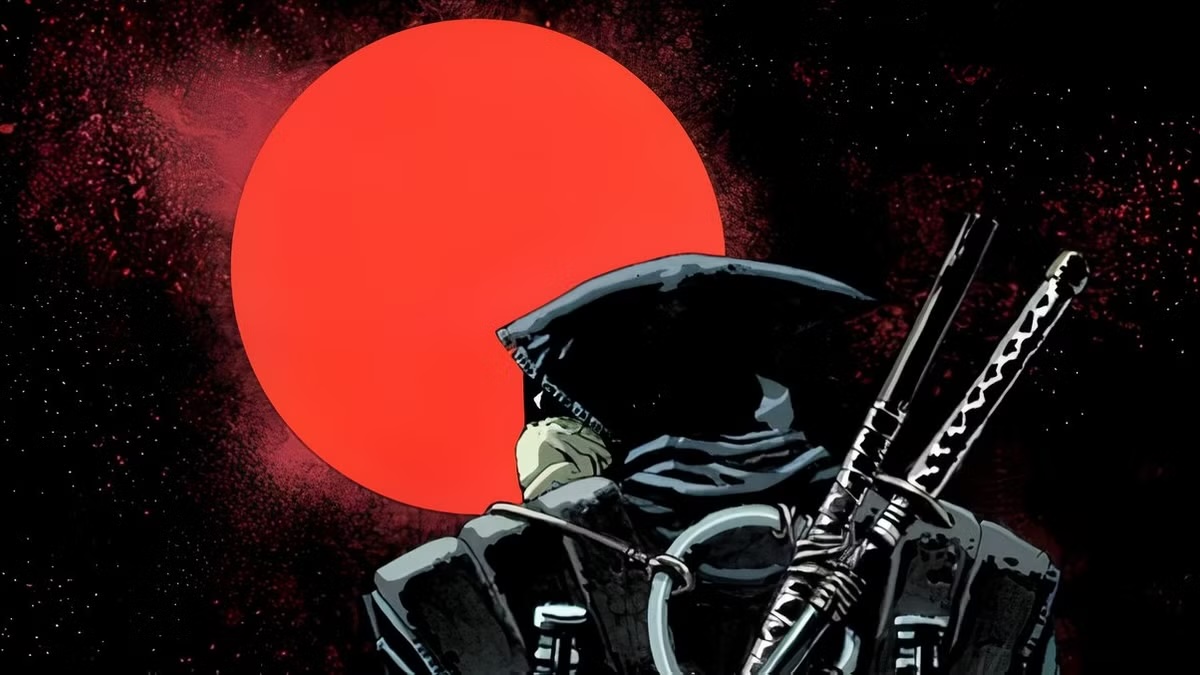
One Turtle survives. That is the premise, stated flatly on the cover and honored without flinching across the pages that follow. The Last Ronin opens after the family is already dead. The reader arrives not at a tragedy but at its aftermath, walking into a New York that has outlived the four brothers it once contained. Whichever Turtle this is matters less, at first, than the fact that he is alone, and that loneliness is the actual subject the book has set out to dramatize.
There is a structural decision here worth sitting with. Eastman and Laird, returning to characters they made together in 1984, build the story around concealment. The surviving brother's identity is withheld through much of the narrative, his name a wound the book refuses to dress. We learn the others through flashback, in a different visual register, rendered so that memory and present action never share the same skin. The past is colored. The present is grief.
What the colour is doing
The most articulate argument in this book is not in its script. Luis Antonio Delgado and the art team split the timeline by palette, and that split does more philosophical work than any line of dialogue. The flashbacks to the four brothers carry full, warm color. The present day of the lone survivor drains toward monochrome, broken by selective accents that function like intrusions of feeling into a numbed world. The page is telling you that the living present is the impoverished state and the dead past is where richness lives. That is a precise visual claim about what grief does to perception. It does not make the world darker. It makes it thinner.
Ben Bishop's linework in the present-day sequences carries a fatigue that the writing only gestures toward. This is a body that has stopped expecting relief. When the action comes, and it comes with the brutality the premise demands, the violence reads less as catharsis than as a man trying to feel something through impact. The book understands that revenge is a way of staying in motion so that you do not have to stop and notice that everyone is gone.
The contradiction the revenge plot cannot resolve
Here is the fault line. The Last Ronin wants to be an elegy and a revenge story at once, and those two things want different endings. An elegy asks you to dwell, to refuse the consolation of resolution, to let absence remain absent. A revenge story asks you to convert grief into a sequence of objectives, each death a step toward closure. The book stages this conflict inside its protagonist, who is mourning and hunting simultaneously, but it does not quite admit that the hunt is a defense against the mourning. The structure offers him a target. Mourning offers no target at all. That is precisely what makes it unbearable, and precisely what the revenge framework lets him avoid.
The question the book raises but does not press is whether the surviving brother actually wants to complete his mission. Because completion means there is nothing left to do but feel. As long as an enemy remains standing, he can postpone the moment of being simply, finally, a person whose entire family is dead and whose purpose has expired with them. The revenge plot is a way of not arriving at that moment. Watch how the book treats the approach to its endgame and ask whether the pacing is reluctance dressed as momentum.
1984 and 2022, looking at each other
It matters that this story sat unmade for decades. Eastman and Laird conceived the core of The Last Ronin early, and what reaches the page in 2022 is two men in late career returning to a creation that long ago escaped them into cartoons, toys, and films that smoothed every hard edge the original black-and-white comic had. The Turtles became a property. The Last Ronin reads, in part, as an attempt to make them mortal again, to insist that characters who were merchandised into immortality can in fact be killed, mourned, and ended.
There is something almost confessional in that impulse. A creator looking at a thing he made forty years ago, watching it outlive its own meaning, and writing a story in which the family is destroyed and only the survivor remembers what they were for. The book's grief is partly the grief of authorship: the knowledge that what you made will continue without you, hollowed and repeated, while the original feeling that animated it belongs only to memory, rendered in warmer color than the present can supply.
What it stopped short of
Given its premise, the fully committed version of this book would have left the survivor with nothing on the far side of vengeance. It flirts with that void and then, characteristically, reaches toward continuation, toward legacy, toward the next generation that lets the franchise persist. This is the gap between what the work attempts and what it achieves. It dramatizes an ending and then declines to end. Whether that is a failure of nerve or an honest admission that these characters were never permitted to truly die is the question the reader is left holding. The book cannot answer it because the answer is not inside the story. It is inside the machinery that keeps the Turtles alive long past the point where any single creator controls them.
Sit with that. A revenge tale about a sole survivor, written by the men who first imagined the brothers, that cannot quite let its last hero stop fighting and grieve. The most human thing in The Last Ronin is not the survivor's rage. It is the thing his rage is protecting him from, and the way the book, like the man, keeps finding reasons not to look at it directly.